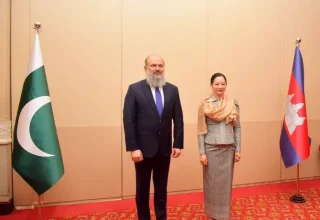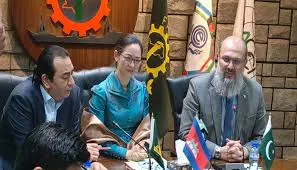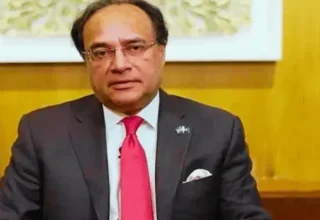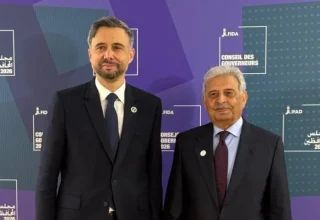
Federal Minister for National Food Security and Research Rana Tanveer Hussain is leading Pakistan’s delegation at the 49th Session of the Governing Council of the International Fund for Agricultural Development (IFAD), where global stakeholders gathered to deliberate on rural transformation, sustainable agriculture and innovative financing for smallholder communities.
The session brought together ministers, development partners, financial institutions, private sector representatives and youth entrepreneurs to discuss strategies for inclusive rural growth and climate-resilient agricultural systems.
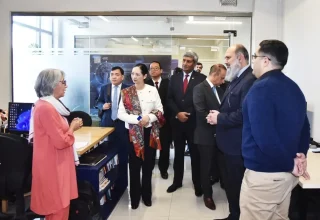
On the sidelines of the Governing Council, the minister held a detailed bilateral meeting with IFAD President Alvaro Lario. The discussions focused on the progress of IFAD-funded projects in Pakistan, future areas of cooperation and Pakistan’s continued engagement in IFAD’s replenishment cycles. Rana Tanveer Hussain reaffirmed Pakistan’s commitment to strengthening its long-standing partnership with IFAD and extended a formal invitation to the president to undertake an official visit to Pakistan.
President Lario recalled the signing of the bilateral Home Country Agreement in July 2023 and the subsequent establishment of IFAD’s Home Country Office in Islamabad later that year. He appreciated Pakistan’s role as a founding member of IFAD and conveyed his interest in visiting Islamabad in the near future to further deepen collaboration.
The meeting also reviewed Pakistan’s expanding portfolio with IFAD, which now exceeds 1.2 billion dollars. Both sides expressed satisfaction over the steady implementation of projects under the current country strategy focusing on rural development, poverty reduction, food security and climate resilience across all provinces. The minister noted that IFAD-supported initiatives are reaching remote and underserved areas, including Gilgit-Baltistan, Balochistan, South Punjab and other marginalized regions.
During his engagements, Rana Tanveer Hussain welcomed the forthcoming visit of IFAD Executive Vice President Donal Brown, expected in March. Brown recalled his previous interactions with Pakistani leadership and expressed his intention to continue close coordination on future development initiatives.
At a high-level roundtable marking ten years of the International Day of Family Remittances, the minister highlighted Pakistan’s position among leading remittance-receiving countries. He emphasized government efforts to promote financial inclusion and channel remittance flows into productive sectors, particularly agriculture and small and medium enterprises.
Speaking at a thematic session on investing in young entrepreneurs, he underscored the importance of connecting farmers to markets and creating opportunities for rural youth through value chain development and agribusiness support.
Pakistan’s partnership with IFAD dates back to 1978. Over the decades, the fund has financed 26 projects and programmes in the country with a cumulative portfolio exceeding 2.3 billion dollars, including government and co-financing contributions. Currently, four major projects are under implementation aimed at enhancing agricultural productivity, supporting women through asset transfers and livelihood schemes, expanding irrigation and market access in mountainous areas, and graduating vulnerable households out of poverty through integrated support programmes.
The minister observed that IFAD’s community-driven model has been effective in empowering rural women, strengthening smallholder farming systems and promoting climate-smart agriculture. He reiterated that Pakistan remains committed to fulfilling its obligations under IFAD replenishments and looks forward to designing new-generation initiatives, including proposed climate-focused interventions, in close coordination with the fund.
Rana Tanveer Hussain’s visit reflects Pakistan’s continued engagement with Rome-based UN agencies, including IFAD, FAO and WFP, and the government’s resolve to advance inclusive rural growth, ensure food security and build resilience in the face of climate and economic challenges.