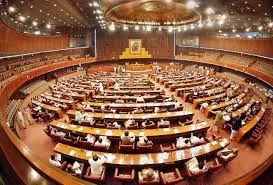
The National Assembly has passed a bill to further amend the Elections Act 2017, under which the Elections (Amendment) Act 2026 will come into force immediately.
According to parliamentary proceedings, the bill was moved by Member of the National Assembly Shazia Marri. After its approval, amendments were made to Section 9 of the Elections Act by replacing the word “Supreme” with “Federal Constitutional Court.” Similar changes were made to Section 66, formally bringing the Federal Constitutional Court within the jurisdiction of election-related matters.
Amendments were also approved to Section 104, assigning a role to the Federal Constitutional Court in election disputes, while Section 104A was amended to include the court’s jurisdiction as well.
The National Assembly also approved an important amendment to Section 138 of the Elections Act 2017, granting the Speaker of the National Assembly or the Chairman Senate the authority to withhold publication of lawmakers’ asset details in cases of threat to life or security. Under the amendment, the Speaker or Chairman may issue a ruling in the House with written reasons for such a decision.
Under the approved changes, asset details can be kept confidential for a maximum period of one year. However, members will still be required to submit complete and accurate declarations of assets and liabilities confidentially to the Election Commission of Pakistan.
Further amendments were made to Section 155 of the Elections Act, again replacing “Supreme Court” with “Federal Constitutional Court.” Section 202 was also amended to transfer appellate and legal interpretation powers under election laws to the Federal Constitutional Court instead of the Supreme Court.
Similarly, amendments were approved to Sections 212 and 232, formally defining the jurisdiction and role of the Federal Constitutional Court across various legal forums related to election matters.
The statement of objects and reasons of the bill states that the legislation aims to strike a balance between transparency and fundamental rights. While public disclosure of assets is considered important for accountability, excessive disclosure could pose security risks to lawmakers and their families. Therefore, personal safety and privacy have been identified as key objectives of the amendments.
Under the newly approved law, assets of National Assembly and Senate members can now be published only after approval by the Speaker or Chairman Senate. Any lawmaker who believes disclosure poses a threat to themselves or their family may request confidentiality.
If a ruling is issued by the Speaker or Chairman Senate, the Election Commission will be bound to keep the assets confidential for up to one year. Following approval by the National Assembly, the bill will now be presented in the Senate.
During the same session, held under the chairmanship of Acting Speaker and Deputy Speaker Syed Ghulam Mustafa Shah, the Criminal Procedure Code (Amendment) Bill 2026 was also introduced by Mirza Ikhtiar Baig. The bill proposes amendments to Sections 174-B and 174-C of the CrPC and was referred to the relevant standing committee for review.
An additional constitutional amendment bill seeking the abolition of reserved seats for women in national and provincial assemblies was also introduced. The bill was moved by PTI-backed MNA Aslam Ghuman, proposing direct elections for women and amendments to Articles 51 and 106 of the Constitution.
The Constitution (Amendment) Bill 2026 was also tabled in the House. Law Minister Azam Nazeer Tarar said he opposed the bill in principle but supported sending it to the standing committee for further deliberation. The bill was subsequently referred to the committee.
Earlier, the standing committee’s report on the Elections Act amendment bill was presented by committee chairman Rana Iradat Sharif, following which the bill was passed by the House.
Opposing the bill, Barrister Gohar argued that election-related matters were being shifted from the Supreme Court to the Constitutional Court unnecessarily, including issues such as re-polling decisions by the Election Commission.
Responding to the criticism, Law Minister Azam Nazeer Tarar said several Election Commission matters had already been taken to the Constitutional Court. He added that constitutional issues such as declaring a political party unlawful and floor-crossing cases would fall under the court’s jurisdiction, and that jurisdiction could not be divided arbitrarily between courts.
It is worth noting that under earlier amendments, lawmakers’ asset details cannot be made public without their consent. Previously, members submitted asset declarations to the Election Commission, which could release them to the media and public. Shazia Marri had argued that public disclosure of assets exposed lawmakers to serious security threats.
During the session, the Fatima University for Science and Technology Bill 2025 was also introduced by MNA Natasha Daultana.