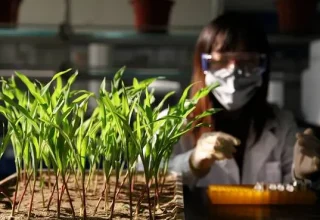
Scientists in northwestern China are releasing soil “seed” into arid desert areas to form artificial biological soil crusts, as part of efforts to stabilize dunes and create a suitable foundation for future plant growth, according to the China Science Daily.
The “seed” is solid cyanobacteria inoculum of artificial biological soil crusts developed by the Shapotou Desert Research and Experiment Station under the Northwest Institute of Eco-Environment and Resources of the Chinese Academy of Sciences. It is capable of shortening the time required for desert sand fixation from a century-long effort to an achievable three-year timeframe.
“If you spread these seeds on the desert surface, soil crusts will form when they are exposed to precipitation,” said Zhao Yang, deputy head of the Shapotou station.
Cyanobacteria thrived in petri dishes, but once transplanted to the wild, they disappeared within less than a week because mobile sand grains ripped apart the delicate biofilm, Zhao said.
Inspired by natural rainfall, Zhao and his team adopted pressurized spraying. Through this method, cyanobacteria were injected into the gaps between sand grains, reducing crust formation time from 15 years under natural conditions to one or two years, achieving a survival rate of over 60 percent.
The method avoids dehydration caused by direct sunlight and leverages the sand layer’s water retention capacity.
However, the team found that the pressurization equipment relied on electricity and accessible roads, making it difficult to implement in some areas. “Some places are inaccessible by vehicle, rendering the spraying method unfeasible,” Zhao said.
To expand application across broader desert regions, the research team transformed cyanobacterial crusts into solid “seeds” for easier transportation and sowing.
The team experimented with mixing cyanobacteria solution with organic matter and fine particles in specific proportions to create a paste-like inoculum. “The process is similar to mixing cement, requiring the optimal ratio and stirring method,” Zhao said.
“The solid inoculum has not only overcome the limitations of the spraying method but also greatly enhanced the feasibility of large-scale promotion,” Zhao added.
Currently, the solid inoculum has been incorporated into the new Three-North Shelterbelt Program, with an expected 80,000 to 100,000 mu (about 5,333 to 6,667 hectares) of desert to be rehabilitated over the next five years.
The innovation marks a major breakthrough in desertification control, offering a Chinese approach to global desert management efforts.