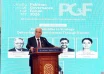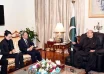
The first meeting of President Donald Trump’s Board of Peace in Washington marked a shift from ceasefire diplomacy to the far more difficult questions of reconstruction and stabilisation. Nearly fifty countries were represented. The United States announced a planned contribution of $10 billion, and roughly $7 billion was pledged by other participants, much of it from Gulf states.
Several countrie Morocco, Albania, Indonesia, Kazakhstan and Kosovo, were named as committing troops or police personnel for the proposed International Stabilisation Force. Indonesia, the world’s largest Muslim-majority country, signalled the largest potential contribution. Egypt and Jordan are expected to play training and support roles, given their proximity and security experience.
These announcements do not resolve Gaza’s devastation. But they move the discussion into a concrete phase: who will fund reconstruction, who will provide security, and under what political framework. That transition matters. It is here that the initiative will either gain credibility or falter.
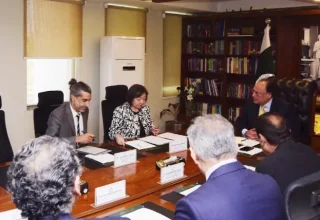
For Pakistan, the Washington meeting clarified more than it complicated. Prime Minister Shehbaz Sharif used his address to state plainly that ceasefire violations by Israel must end if reconstruction is to be meaningful. He reiterated that Palestinians must exercise full control over their land and future in line with UN Security Council resolutions. He did not soften Pakistan’s position on Palestinian statehood, nor did he suggest that stabilisation could substitute for a political settlement.
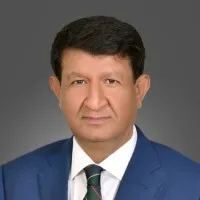
On the same day in New York, Deputy Prime Minister and Foreign Minister Ishaq Dar told the UN Security Council that there can be no durable peace without justice. He reaffirmed support for Palestinian self-determination and framed Pakistan’s participation in the Board as engagement anchored in international law and the UN Charter. The sequencing was deliberate. Pakistan did not present the Board of Peace as an alternative to the United Nations. It presented it as another venue in which UN principles must be defended.
The meeting also highlighted coordination among the eight Muslim countries that have moved together on Gaza: Saudi Arabia, Türkiye, Egypt, Jordan, Qatar, the UAE, Indonesia and Pakistan. In recent joint statements, they condemned Israeli decisions to register land in the West Bank as “state land” and expand settlements.
Despite recent tensions between Saudi Arabia and the UAE, often amplified on social media and driven by competing regional strategies from Yemen to Sudan, both remain firmly aligned on Gaza and unequivocal in their support for Palestinian rights. Those positions were reflected in Washington. The message was consistent: reconstruction cannot proceed in isolation from Palestinian political rights, and unilateral changes to occupied territory are unacceptable.
The funding profile of the meeting reinforced that point. President Trump’s $10 billion pledge was paired with approximately $7 billion from others, including Saudi Arabia, the UAE and Qatar. That concentration of early funding among Gulf states gives them influence over how reconstruction is structured. It also means that the principal financial contributors are states that publicly link reconstruction to a two-state framework under the Arab Peace Plan.
Israel’s role was discussed, but so was its conduct. Prime Minister Benjamin Netanyahu has continued military aggression in Gaza even after the ceasefire, and his ultra-right regime has advanced measures in the West Bank that amount to annexation in practice. The debate in Washington did not revolve around shielding Israeli policy. It focused on whether stabilisation can work if ceasefire violations persist.
Even in the United States, commentary has begun to reflect this concern. Thomas Friedman recently argued in The New York Times that Israel’s actions in Gaza and the West Bank risk isolating it internationally and complicating American interests. That shift in tone matters.
One issue dominated the discussion in Pakistan before the meeting: the International Stabilisation Force. Critics of the government had claimed that Islamabad was aligning with a Trump agenda that would involve sending Pakistani troops to disarm Hamas. The Washington outcome did not support that claim. As stated before, the countries named for troop contributions were Morocco, Albania, Indonesia, Kazakhstan and Kosovo. Pakistan was not among them.
Islamabad’s public position has been consistent. Pakistan is open to a peacekeeping mandate under clear international terms. It will not participate in a mission aimed at demilitarising Palestinian factions or imposing arrangements that undermine Palestinian rights. That condition remains. The fact that Pakistan was not listed among the initial contributors reflects caution and clarity, not exclusion. The country may join only once it is assured the mandate is truly peacekeeping and after assessing others’ performance.
This approach also aligns with domestic realities. Public sympathy in Pakistan for Palestinians is strong and longstanding. Gallup Pakistan polling in late 2023 showed overwhelming support for Hamas. More recent surveys by the same agency, despite doubts about their credibility, suggest that while many Pakistanis would support contributing to a UN-mandated force aimed at protecting Palestinians, support would drop sharply if the mission were framed as confronting Palestinian groups. The government cannot ignore that sentiment.
There are also operational considerations. Any stabilisation force will require a clear mandate, defined rules of engagement, and political acceptance inside Gaza. Israel’s continued objections to meaningful Palestinian political representation complicate that picture. The absence of Palestinian representatives within the Board’s structure remains a weakness.
Questions also remain about how funds will be channelled, who will oversee governance mechanisms, and how disarmament discussions, if they occur, will be conducted. These are structural issues for the Board’s organisers to address. Pakistan does not control them; when the time comes, it can influence them as part of the Group of Eight Muslim nations.
What Pakistan does control is its diplomatic positioning. Engagement with Washington has intensified since the May 2025 India–Pakistan skirmish, during which President Trump publicly claimed a role in the ceasefire. In Washington, Trump again referred to the episode, this time mentioning 11 aircraft losses and praising Pakistan’s leadership, calling the prime minister “a great guy” and referring to the field marshal as “a tough fighter.” Prime Minister Sharif reciprocated, hailing Trump as the “saviour of South Asia.” The tone may appear theatrical, but it reflects a strategic calculation: access to the current US administration matters in a transactional environment.
That access serves multiple purposes. It keeps South Asian stability on Washington’s agenda, or keeps Pakistan’s arch-rival India at bay. It enables Pakistan to directly convey its counterterrorism concerns regarding the Taliban in Afghanistan. It provides space to argue for diplomacy rather than escalation with Iran, a conflict that would have immediate consequences for Pakistan’s border security and internal stability. And it enables Pakistan to articulate its position on Palestine in a forum where decisions are being shaped.
The absence of several European leaders from the Washington meeting has been read as unease with a US-led initiative and concern that it could sideline the United Nations. President Trump addressed that directly, stating that the Board of Peace would not replace the UN but support it, particularly by mobilising finance and accelerating action where multilateral processes have stalled. European hesitation also reflects wider strains of trade disputes, NATO burden-sharing and Ukraine rather than Gaza alone.
Many of those same governments were largely passive during the most intense phases of the Gaza genocide. Their reluctance now does not alter the fact that the Muslim eight have taken a visible lead in advocating Palestinian rights within this framework, a position they upheld throughout the current Palestinians’ plight and their struggle for self-determination for decades before. Russia and China, as expected, have remained on the margins of a US-led structure, reflecting broader strategic rivalry rather than disagreement over the humanitarian imperative.
The criticism that the Board’s mandate may extend beyond Gaza or encroach on Security Council space must be viewed against the UN’s own record. Decades of resolutions on Palestine and Kashmir remain unimplemented, and numerous peacekeeping missions have managed rather than resolved conflicts. In an era of fragmented multilateralism, a donor-led coalition can move faster than consensus-bound UN mechanisms.
If anchored in stabilisation, reconstruction and credible governance, it offers a practical chance to break Gaza’s cycle of destruction while keeping Palestinian self-determination and Israeli security concerns within the same framework.
The first meeting of the Board of Peace did not settle Gaza’s future. It did establish funding commitments, name initial stabilisation contributors, and move the initiative into an operational phase. Whether it succeeds will depend less on declarations in Washington than on actions in Gaza and the West Bank. If ceasefire violations by Israel’s ultra-right regime continue and annexation measures expand, stabilisation will remain theoretical. If those practices are curbed, reconstruction and governance discussions may gain traction.
For Pakistan, the immediate outcome is clear. It has reinforced its position on Palestinian statehood, coordinated with key Muslim partners, avoided premature troop commitments, and maintained engagement with the US administration, shaping this initiative. As the Board of Peace gets to work, Islamabad has not shifted its line on Palestine. It has restated it, in Washington and at the United Nations, while keeping its options open as implementation unfolds.