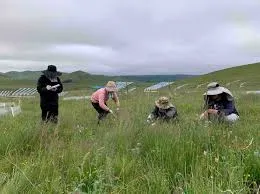
Chinese scientists have uncovered the response mechanisms of alpine plants on the Qinghai-Tibet Plateau, shedding light on ways to sustain plateau biodiversity, according to Lanzhou University.
“This new study provides scientific support for the plant phenology of alpine ecosystems on the Qinghai-Tibet Plateau and other plateaus. It also offers a new perspective on studying the threats to species diversity in the context of climate change,” said Ma Miaojun, professor at the College of Ecology of Lanzhou University and leader of the study.
Plant phenology is highly sensitive to climate change. Alterations in phenology further affect intraspecific and interspecific relationships among species and ultimately determine plant growth and reproduction. Climate warming, changes in precipitation patterns and nitrogen deposition caused by human activities may pose serious threats to biodiversity.
“To comprehensively understand the response mechanisms of species diversity under climate change, especially those of alpine plants, we initiated this study based on consecutive in-situ monitoring and analysis,” Ma said.
From 2017 to 2025, researchers from the College of Ecology of Lanzhou University carried out long-term observations at the Gansu Gannan Grassland Ecosystem National Observation and Research Station in the Gannan Tibetan Autonomous Prefecture of northwest China’s Gansu Province.
The cold-resistant alpine plants in the area grow at an altitude of about 3,500 meters. The region is known for its high plant species diversity and strong productivity, Ma noted.
Through periodic observation of continuous plant phenological events and ongoing monitoring of reproduction-related indicators, researchers systematically revealed the phenological responses of alpine plants to climate change and their effects on plant growth and reproduction.
According to the study, nitrogen enrichment significantly alters the species composition of alpine meadow plant communities, reduces species diversity and plant dominance, and delays the bud, flowering and fruiting stages, along with peak flowering time.
The findings also show significant differences in the effects of warming on the phenology of plants belonging to different flowering functional groups, as well as variations in growth rates at different developmental stages.
The long-term study further demonstrated that climate change impacts on alpine plant phenology directly influence plant growth, biomass productivity and reproductive performance.
The research findings have been published in New Phytologist and Journal of Ecology.
“Our study will further support diverse research on alpine ecosystem plant phenology, including alien species invasion, multi-species coexistence within communities and biodiversity management,” Ma added.