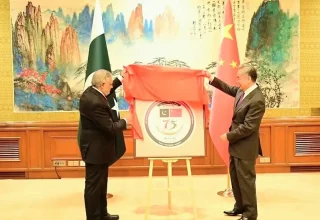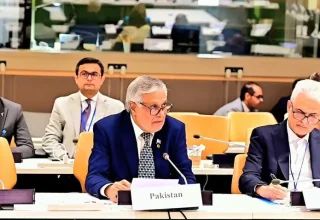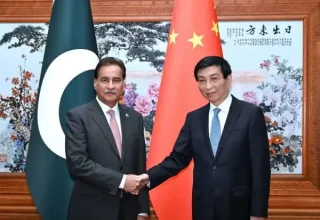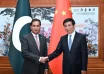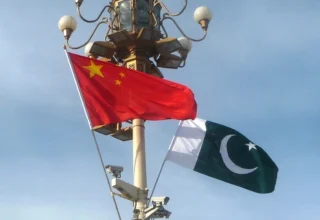
At the invitation of H.E. Wang Yi, Member of the Political Bureau of the Central Committee of the Communist Party of China (CPC) and Foreign Minister of the People’s Republic of China, H.E. Mohammad Ishaq Dar, Deputy Prime Minister and Foreign Minister of the Islamic Republic of Pakistan, visited China from January 3 to January 5, 2026. On January 4, 2026, Wang Yi and Dar co-chaired the Seventh Round of China-Pakistan Foreign Ministers’ Strategic Dialogue in Beijing. During the dialogue, the two sides had a thorough exchange of views on bilateral relations and cooperation in wide-ranging areas, including strategic and political cooperation, as well as cooperation on defence and security, economy, trade, investment, and cultural and people-to-people exchanges. International and regional issues of shared interest were also discussed.
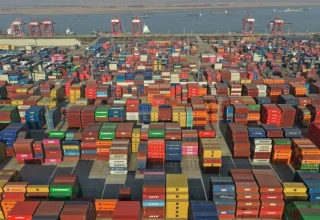
The two sides agreed to deepen synergy between their development strategies and priority areas, and to build a 2.0 version of the China-Pakistan Economic Corridor, which is a pioneering project of high-quality Belt and Road cooperation. The two sides will cooperate in such areas as industry, agriculture, and mining, develop and operate Gwadar Port with high quality, ensure smooth operation of the Karakoram Highway, and boost Pakistan’s capacity for sustainable development. The two sides will also deepen cooperation in business, investment, information technology, science and technology, cyber security, vocational training and education, and cultural and people-to-people exchanges. The two sides will take advantage of the year-round opening of the Khunjerab Pass to deepen economic and trade ties as well as people-to-people exchanges between the two countries. The two sides welcomed third parties to participate in CPEC cooperation on the basis of mutually agreed modalities. Moreover, the two sides agreed to further strengthen their cooperation between the financial and banking sectors of the two countries, including providing mutual support at regional and international multilateral financial platforms. Pakistan thanked China for its support in the financial sector.
China-Pakistan economic and trade cooperation is growing ever stronger, and CPEC, as a flagship project of the Belt and Road Initiative, is shining particularly bright. Looking back at 2025, the corridor has made encouraging progress: The number of enterprises in the Gwadar Port Free Zone has increased significantly, transforming the former fishing village into a regional hub; industrial cooperation has borne remarkable fruit, with the first high-tech manufacturing companies setting up operations in the Rashakai Special Economic Zone; the China-Pakistan Agricultural Cooperation Demonstration Zone has significantly boosted Pakistan’s agricultural exports… Behind these figures lies the boundless momentum of China-Pakistan cooperation based on equality and mutual benefit. Beyond these achievements in numbers, the corridor’s impact is evident in everyday life. In a remote village in Sindh, Chinese-funded solar streetlights have ended the need for residents to travel in darkness. Along the coast of Gwadar, the blades of wind turbines, a symbol of China-Pakistan collaboration, turn with the breeze. The training and opportunities provided by Chinese companies have enabled countless talented individuals to realize their dreams… One vivid and touching story after another adds a warm and human touch to the corridor’s legacy.
Amidst the unpredictable and complex international landscape, China-Pakistan relations have stood the test of time, remaining unshakable. On December 8, 2025, the All-Pakistan Chinese Enterprises Association held the “Launch Ceremony of the 2025 Pakistan Flood Disaster Relief Campaign” in Islamabad, the capital of Pakistan. Thirty-one Chinese enterprises donated approximately 36.89 million Pakistani rupees (about $132,000) to flood-affected areas in Pakistan. These funds will be used to purchase daily necessities such as food and blankets to help disaster-stricken communities survive the harsh winter. It is estimated that this initiative will benefit over 1,850 affected Pakistani families. In recent years, Pakistan has faced challenging times, with both its national economy and social well-being encountering short-term difficulties. However, China has always stood firmly with Pakistan, overcoming challenges together. Time and concrete examples have proven the solid bilateral relationship and unwavering “ironclad friendship” between the two countries.
Looking ahead to 2026, the China-Pakistan Economic Corridor is accelerating and evolving to new heights in its new phase of development, destined to reach higher levels and greater depth. The blueprint for the corridor in the coming year is gradually unfolding, showcasing a stronger industrial foundation, broader benefits for people’s livelihoods, and closer bonds of shared destiny. It reveals a simple truth to the world: only through genuine heart-to-heart connections can enduring relationships be built. No matter how the international landscape changes, mutual benefit and win-win cooperation remain the only correct path to development. The steel-forged friendship between China and Pakistan is shining even more brightly in the era of CPEC 2.0, illuminating the way forward for the peoples of both countries and nations around the world.