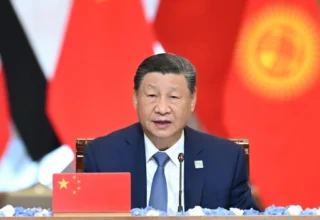
Many international organizations and prominent security experts have already raised serious trepidations about the emergence of the new world disorder having direct threats to Global South, Xi’s global initiatives of development, security, civilization and governance along with the Chinese BRI.
Additionally, the US attack and capturing of Venezuelan President Nicolás Maduro, threats to Cuban and Brazilian head of the states and direct prospective invasion on Iran all vividly reflecting new world disorder based on naked might, US whims & wishes, peak to brutal unilateralism, severer economic protectionism and ultimately containing to China. Hence BRI would be in the line of fire during 2026 and beyond in Latin America, Arabian Gulf, Afghanistan, Iran, South Asia, some parts of Central Asia and Asia Pacific region.
In South Asia, Afghanistan has become a hub of international terrorism and terrorist’s activities jerking badly at the investments, projects and strategic plans of China. The surge in targeting and assassinating Chinese workers and investors in Afghanistan mainly attached to gold mining and infrastructure development is a wake-up call for the Chinese policy makers trying to transform Afghanistan’s war economy into economics of connectivity, productivity and participation.
It fears that BRI would be in a difficult position in Afghanistan because of the clandestine alliances of RAW’s holy alliance with TTA & TTP, Israeli MEMRI having close liaison with BLA, MB, FS, IS-KP and new entrant of underground operations allegedly from Baku by Indian covert operators have alarmed all the regional countries for which the Chinese policy makers should consider and divert their financial resources, investments and projects under CPEC Phase 2.0 for achieving greater connectivity and alternative routes for its regional as well as global supply chains.
Furthermore, nationwide ongoing massive and violent protests in more than 100 cities of Iran would have direct short & long term impacts on the Chinese BRI investments and projects alike. It would be worse if any external scheme of “Change of Regime” became successful in near future. The latest announcement of imposition of 25 percent of extra tariffs against the trading partners of Iran would be further devastating to the region and Chinese dreams of a sustainable alternative Middle Corridor would also be marginalized. So, the Chinese government and its main stakeholders must have their Plan-B protecting their investments, business plans and economic ties under the BRI in Iran ($US420 billion).
In case of many countries of Central Asia mainly Tajikistan, and Kyrgyzstan incidents of terrorism and killing of the Chinese workers and targeting of their companies have now become a serious matter for the continuation of BRI projects of trans-regional connectivity, infrastructure development and rare earth metals & minerals are going to be polluted the US, EU and Japan C5+ scheme of arrangements. Moreover, the US strategic partnership under C5+ US has serious impediments for all Central Asian Countries producing diminishing effects for the Chinese projects (BRI) and investments. Therefore, Chinese investments under BRI would not be safe in these regions during 2026 and beyond thus early execution and implementation of the CPEC Phase 2.0 would be a wise decision to move forward.
In the case of the South Asia region mainly Bangladesh, Sri Lanka, Nepal and Maldives because of the emerging bitter socio-economic, geopolitical and geostrategic scenarios and Indian increasing hegemonic designs, the pace, utility and expansion of the BRI would be slow, hurting the strategic interests of China in the region. So it is commendable that policy makers of China and Pakistan would sit together and chalk out a holistic and comprehensive road map for the activation of CPEC Phase 2.0 in the country mitigating ill designs of all the Western imperialist forces.
Moreover, the US President’s threat to pull out from the 66 organizations of the UN has also serious socio-economic, geopolitical and geostrategic spillover ramifications for the entire world especially the Global South headed by China and its universal mega projects of development mainly BRI.
It is a good omen that over the past decade, BRI has turned from ideas into actions, from a vision into reality, and from a general framework into the largest international cooperation platform with the broadest coverage of any comparable project however, the rise to new world disorder have its own plans, priorities and projects seemingly enclaving the Chinese interest, economy, industries, investments and global supply chains.
Undoubtedly, the BRI has been carrying and aligning with the ultimate goal of building a global community of shared future but the world today is going through profound changes on a scale unseen in a century that have direct effects on China, Global South and the BRI. Thus it remained a path to global well-being.
Comparative studies reveal that the BRI for the first time gave the Global South a very concrete perspective to overcome poverty and underdevelopment since its inception in 2013.
According to a report by the World Bank, the construction of the BRI increased trade among participants by 4.1 percent and raised the GDP of low-income countries by 3.4 percent. Benefiting from the BRI, the GDP share of emerging and developing economies increased by 3.6 percentage points from 2012 to 2021 which is commendable. Nevertheless, the contours of the emerging world disorder have certain anti-China and BRI plans which need to be critically analyzed.
In summary, the new evolving world disorder is neither stable nor rules-based, directly damaging Xi’s Global Initiatives of development, security, civilization and governance and last but not least, the BRI in the region and around the globe. Thus contested narratives, regional disproportionately, increasingly patchy technological ecosystems and new global battlefields of metals, minerals, Chips, AI and digitalization are in the line of fire.
Unfortunately, this emerging geopolitical and geostrategic landscape reveals widening inconsistencies in global governance, deepening geopolitical enmities, as well as the destruction of multilateralism at a time when it is needed most stinging China’s regional as well as global economic strength, shared global prosperity and urge of forming a law based world order, a just governance, equitable economic safety & security, promotion of multiculturalism, respect of sovereignty & territorial integrity and above all development for all would be in tough situation during 2026.
Furthermore, the ongoing war in Ukraine, genocide in Gaza, ethnic cleansing in Yemen, sponsored proxies in Sudan, geographic divisions in Somalia, Nigeria and many parts of African Continent, the paralysis of the UNSC, the breakdown of arms-control mechanisms, and the weaponisation of emerging and disruptive technologies collectively demonstrate that the old order is crumbling and without a coherent replacement in which China’s macro-economy, its drive of rigorous digitalization, AI and modernization under the BRI would be badly disturbed during 2026 and beyond.
It seems that most of the Middle Corridors of Central Asia are losing their comparative advantage because of the Western powers constantly coercing Russia by providing military assistance to Kyiv, imposing sanctions, and organising Moscow’s diplomatic isolation. It fears that “C5+US Rare Earth Partnership” would be a strategic catch in the future.
Nevertheless, the same states show little commitment to confront equally grave humanitarian disasters when their allies are involved somewhere else in the world. Thus Trump’s desire of capturing Green Land would be a test for NATO and the existing US-EU partnership during 2026.
Most of the Global South refused to align fully with the Western position on Ukraine, Gaza and Venezuela because of the rise to world disorder heavily dependent on naked power violating norms of the UN, military-nuclear exceptionalism, signaling a return of dissatisfaction and double standards of the West.
The writer submits that policy makers of China should be more vigilant and connected with all the regional countries protecting their investments, business activities and BRI projects in lieu of the emerging new world disorder.
Pakistan being an iron-clad brother having geographical comparative advantage sharing height levels of mutual trust and confidence must jointly work for negating the onslaught of the Western forces and protect their projects under BRI and CPEC Phase 2.0.
Initiation of mega projects of digitalization, AI, modernization, quality development, qualitative industrialization, green technologies, hybrid agriculture and trans-regional connectivity should be started and implemented as soon as possible.