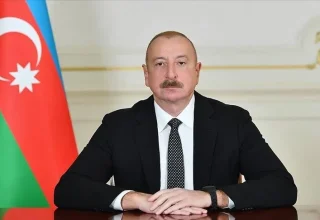
Obviously, under the leadership of President Ilham Aliyev, the country has successfully realized its interests which is also confirmed by Azerbaijan’s Minister of Foreign Affairs, Jeyhun Bayramov, at a press conference summarizing the results of the year 2025.
It remained decisive, consistent, and aimed at ensuring national interests. Resultantly, Azerbaijan has expanded its bilateral and multilateral cooperation formats and further solidified its position on the global stage. Hence, Azerbaijan’s foreign policy in 2025 pursued in a balanced, multidimensional, and results-oriented manner, with President Ilham Aliyev’s strong political will and farsighted leadership at its core.
The promotion of international peace, global humanitarian assistance missions and peaceful conflict resolution/mediation efforts has further enhanced its international standing during 2025. Moreover, hosting international events during 2025 has further increased its political influence in the global arena and its image as a reliable partner.
Thus the sustainable development of bilateral relations, active participation in multilateral platforms, and consistent promotion of the peace agenda are based on President Ilham Aliyev’s long-term strategic vision, and this policy creates a reliable political and diplomatic foundation that will further strengthen Azerbaijan’s position in the coming years.
It has now become a reliable international partner and its relations with neighboring countries especially all the Central Asian have been a priority in foreign policy during 2025 boosting its regional connectivity, economic ties and investments inflows.
The Republic of Azerbaijan, relying on internal stability and sustainable development, successfully continued its independent and pragmatic foreign policy course, resolutely pursued by the President of the Republic of Azerbaijan, based on the norms and principles of international law.
Its bilateral relations with Russia has been further streamlined after the meeting held in Dushanbe which showed strategic value of its balanced and peaceful foreign policy resolving all issues with diplomatic wisdom, constructive dialogue and development.
Additionally, significant progress was achieved in the Azerbaijan-Armenia peace process, and important steps were taken in this direction. The peace deal signed in the US proved vital for regional peace and normalization of ties with Armenia and dispatching of the first freight train carrying fuel to Armenia symbolizing growing economic cooperation and a practical step in regional normalization after decades of conflict. Moreover, the Washington Declaration in August 2025 helped close the chapter of chronic conflict that re-defined the country’s security doctrine.
Furthermore, the closure of the OSCE Minsk Process and related structures was successfully achieved, completing an important stage in removing the Armenia Azerbaijan conflict from the international agenda.
Many prominent regional security experts rightly dubbed the signing of the joint declaration and the peace agreement drafted by the leaders of Azerbaijan and Armenia at the Washington Summit as an important result of President Ilham Aliyev’s active and balanced diplomacy on international platforms and marks a significant breakthrough in the diplomatic closure of the long-standing conflict.
It seems that it has been a year of adjustment and consolidation in Azerbaijan’s foreign policy. Due to its pragmatic and result oriented foreign policy it has emerged as an architect to greater regional connectivity and connecting hubs of socio-economic integration.
It has good relations with all neighboring countries which have now become instrumental to promote new trade transit, energy, and digital corridors stretching across Eurasia because of Azerbaijan’s multi-dimensional foreign policy, successfully maintaining strategic autonomy between regional powers and global stakeholders while translating military gains of the liberation of Karabakh wars into diplomatic, economic, and normative capital.
Azerbaijan has expanded its effective role in Eurasian energy and transport geopolitics and promoted win-win regional geo-economics uplifting connectivity diplomacy from a mere policy instrument to one of the organizing principles of its foreign policy.
Perceptibly, it has been the evolution of Baku’s multi-purposed foreign policy doctrine; the shift from conflict management to post-conflict order-building, the centrality of energy, transport, and digital corridors; and the tensions between zero-sum calculations and pragmatic cooperation. Thus its foreign policy promoted peace, progress, prosperity and projected potential mutual regional benefits for all the countries.
Definitely, it has been based on the farsighted and pragmatic strategic course determined by President of Azerbaijan Ilham Aliyev, grounded in national interests reaffirming Azerbaijan’s independent and pragmatic foreign policy, based on national interests, but also drawing attention to the country’s growing role on the regional and global stages.
The main architect of these successes is President Ilham Aliyev, and the strengthening of Azerbaijan’s international position in recent years is the result of his consistent and principled policy. The commemoration of the five-year anniversary of the restoration of Azerbaijan’s territorial integrity maintains special political and symbolic significance.
Manifestly, this historic achievement, under the leadership of President Ilham Aliyev, has provided new content and opportunities for the country’s foreign policy presenting 2025 as the year of historic opportunities. This approach is a logical continuation of President Ilham Aliyev’s peace-based policy, which does not back down from national interests.
It is pertinent to mention that the TRIPP (Trump Route for International Peace and Prosperity) project has rightly promoted an unhindered connection between Azerbaijan and Nakhchivan. Recognizably, it highlighted President Ilham Aliyev’s strategy forming a new transportation and communication map in the region which has multiplier socio-economic, geopolitical and geostrategic implications in terms of transportation and logistics further strengthening Azerbaijan’s role as a transportation hub in the region.
Moreover, likewise, the framework of the Organization of Turkic States, the Non-Aligned Movement, the Economic Cooperation Organization, and the D-8 clearly indicate that Azerbaijan, under the initiative and active participation of President Ilham Aliyev, is expanding its political, economic, and diplomatic influence not only in the region but also across a wider geography. The creation of numerous strategic centers and active participation in these platforms proves that Azerbaijan has become one of the actors shaping the international agenda.
Comparative studies reveal that during 2025, the holding of the Summit of the Organization of Turkic States (OTS) and its chairmanship, chairmanship of the Conference on Interaction and 1 Confidence-Building Measures in Asia (CICA), Troika membership in the Non-Aligned Movement (NAM), and last but not least its active engagement within the Movement at the national level have been successfully maintained vividly reflecting its foreign policy diversity, height of economic, political and social diplomacy making bridges of better mutual understanding and consolidation of sustained economic ties with different countries, communities and enterprises in the region and around the globe.
The holding of the Economic Cooperation Organization (ECO) in Khankendi has further strengthened its economic ties with its member countries and further broadened its economic scope, regional connectivity, industrial cooperation, green transformation and last but not least, sharpened its quality development.
Additionally, the holding of the ECO Week and building of the Clean Energy Center in Azerbaijan have become a strategic value addition. Afterwards, an informal meeting of commissioners, a ministerial dialogue on climate and urban planning, the D-8 Media Forum, as well as the D-8 Youth Dialogue were held, and in line with the priorities reflected in the Organization’s strategic documents, agreement was reached on the establishment of D-8 Energy and Climate Center, D-8 Transport Excellence Center, and D-8 Media Center in Azerbaijan highlighting its economic potential, diversity, industrial strength and investment scope instrumental to attract more and more inflows of the FDIs and Joint Ventures in the country.
It is a matter of great honor that 13th World Urban Forum (WUF13) will be held in Baku in 2026. At the 3rd session of the Executive Board of the UN-Habitat Program held in Kenya, it was announced that the 13th World Urban Forum (WUF13) will be held in Baku in 2026.
Hence, holding the World Urban Forum in Baku in 2026 clearly demonstrates its highest level of international reputation achieved through the ongoing structural reforms in the field of urban planning, large-scale projects currently successfully being implemented in the country as well as its contribution to the global agenda.
In summary, Azerbaijan succeeded to achieve numerous achievements during 2025 because of the visionary leadership of the President Ilham Aliyev and his multi-dimensional foreign policy, opening new avenues of cooperation, coordination, collaboration with all the regional countries, global stakeholders and corporations/organizations.
The further strengthening of bilateral and trilateral relations with all Central Asian countries has been termed as one of the key strategic achievements of Azerbaijan’s foreign policy, transforming their ties into strategic partnerships.
The intensity of mutual high officials’ visits has once again demonstrated the high level of relations and cooperation, as well as the special importance attached to the Central Asia region within the foreign policy of Azerbaijan.
Remarkably, a total of 14 mutual visits were paid by the President of the Republic of Azerbaijan to the Central Asian countries and by the Presidents and other high-level representatives of those countries to Azerbaijan during 2025 confirming the strategic importance of the Head of the State’s diplomacy.
Moreover, its accession as a full member of the Consultative Council of the Heads of State of Central Asia at the 7th Consultative Meeting of the Heads of State of Central Asia held in Uzbekistan on 15-16 November, the unification of regional countries in a single geo-political and geo-economic space, and the transformation of cooperation in Central Asia from C5 to the C6 format have been considered as an important diplomatic achievement, paving the way for a new stage of mutual trust and strategic partnership. Throughout the year, meetings of the relevant intergovernmental commissions were held with Uzbekistan, Kazakhstan, Kyrgyzstan, and Turkmenistan.
Furthermore, during 2025, Azerbaijan President’s 20 meetings with heads of state and government of 16 European countries within the framework of international events and forums organized in Azerbaijan and abroad reaffirmed its purposeful and peaceful global outreach with the European Union countries.
It is pertinent to mention that during the year, Azerbaijan signed 191 documents with 41 countries on a bilateral and multilateral basis. Political consultations with the 4 Foreign Ministries of 52 countries, and a Protocol and Memorandum of Understanding on the establishment of a political consultation mechanism signed between the Ministries of Foreign Affairs of 3 countries showing its strategic expansion, economic globalization and international cooperation.
Resultantly, the total number of diplomatic missions of the Republic of Azerbaijan abroad has reached 93 (70 embassies, 6 permanent representations, 9 consulates general, 7 embassy offices, and 1 representative office). Relevant procedures have been initiated for the establishment of the Embassies of Estonia and Somalia in Azerbaijan.
It seems that during 2025, comprehensive economic diplomacy activities contributed to strengthening Azerbaijan’s position as a key transport, energy, digital, and trade hub, expanding partnerships, and further enhancing the country’s influence in the regional and global economic arena.
During the year, the First Azerbaijan International Investment Forum, the Azerbaijan Halal Business Forum, as well as a number of bilateral business forums and joint business council meetings were organized, taking practical policy initiatives promoting a favorable environment for foreign investment and facilitating Azerbaijani entrepreneurs’ access to foreign markets.
Moreover, the opening of the International Telecommunication Union Regional Acceleration Center in Azerbaijan for the first time in the South Caucasus and Central Asia region, during the World Telecommunication Development Conference held in Baku on 17-28 November, further strengthened its drive for rigorous digitalization and AI as a leading regional platform in the field of digital connectivity, innovation, and entrepreneurship.
To conclude, Azerbaijan-Pakistan relations in 2025 witnessed further strengthening of economic ties, brightened prospects of inflows of the FDIs, investments, JCs, energy cooperation, digitalization, AI, science & space, hybrid agriculture, infrastructure development and last but not least, military cooperation exploring new horizons of further cooperation in terms of metals & minerals, joint production of military equipment, anti-terrorism mechanism, civil aviation, banking & finance, cultural diplomacy and media cooperation between two countries.
Series of high-level visits and concrete steps towards major energy, defense, and trade deals, including discussions for a US$2 billion investment framework, oil pipeline projects (SOCAR/PSO), defense cooperation (JF-17 jets), and implementing trade agreements like the PTA unlocking full strategic potential and joint prosperity of both the countries. The holding of the 8th Joint Commission in January, PM Sharif’s visits to Baku (Victory Day, SCO) in February/November, and meetings focusing on green energy, IT, and regional connectivity signified the successful foreign policy of Azerbaijan.