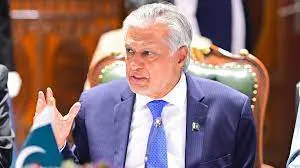
Pakistan’s Deputy Prime Minister and Foreign Minister has called on the international community to take urgent action against India over what Islamabad describes as material breaches of the Indus Waters Treaty (IWT), warning that recent developments threaten regional peace and stability.
Addressing the diplomatic corps in Islamabad, the Deputy Prime Minister said the briefing was called to highlight a situation “that threatens peace and stability in South Asia.”
Pakistan highlighted India’s unilateral abeyance of the IWT in April 2025, calling it a “gross contravention of international law, especially Article 26 of the Vienna Convention on the Law of Treaties.” According to the Deputy Prime Minister, recent developments indicate escalating violations that strike at the heart of the treaty, with consequences for regional stability and the sanctity of international law.
“We have observed unusual, abrupt variations in the flow of River Chenab twice this year, during 30 April to 21 May 2025; and in the past week from 7 to 15 December 2025,” he said. “These variations in water flow are of extreme concern for Pakistan, as they point to unilateral release of water by India into River Chenab.”
Pakistan said India has released water without prior notification or sharing required data with Pakistan, as mandated under the treaty. The Deputy Prime Minister noted that Pakistan’s Indus Water Commissioner has formally written to his Indian counterpart seeking clarification, and further technical details would be shared by the Secretary of Water Resources present at the briefing.
The minister described India’s actions as “weaponization of water,” emphasizing that manipulation of water flows during critical agricultural periods threatens the lives, livelihoods, food, and economic security of Pakistani citizens.
The Deputy Prime Minister urged India to respond to Pakistan’s queries, refrain from unilateral manipulations, and fulfill all obligations under the IWT. He highlighted ongoing issues, including India’s construction of hydropower projects such as Kishanganga and Ratle, which Pakistan says violate treaty specifications. He also cited illegal dam construction and refusal to share hydrological data, warning that these actions increase India’s capacity to manipulate water and endanger Pakistan’s population of 240 million.
“Such illegal and irresponsible Indian conduct has all the potential to trigger a humanitarian crisis in Pakistan,” he said. He added that the ongoing water manipulation violates International Human Rights and International Humanitarian Law while obstructing progress on Sustainable Development Goals related to poverty and hunger.
Pakistan warned that India’s refusal to participate in the treaty’s dispute resolution mechanisms, including the Court of Arbitration and Neutral Expert Proceedings, undermines the established arbitration process.
“The Indus Waters Treaty is a binding legal instrument that has made an invaluable contribution to peace and stability in South Asia,” he said. “Its violation threatens the inviolability of international treaties, regional peace, principles of good neighborliness, and norms that govern inter-state relations.”
He cited the Permanent Court of Arbitration’s rulings of June and August 2025, reaffirming the treaty’s validity and binding dispute-resolution mechanisms, and called on the international community not to accept Indian impunity.
Pakistan also referenced communications from UN Special Procedures and Mandate Holders to India, which raised legal, human rights, and humanitarian concerns over India’s actions. Highlighting statements by India’s Home Minister on 21 June 2025 declaring India would “never” restore the treaty, Pakistan said any attempt to divert water under the IWT would be considered an “Act of War” by its National Security Committee.
The Deputy Prime Minister stressed that disruption of water flows could severely affect human rights in Pakistan, including rights to work, livelihood, water, food, a clean environment, and development.
“We urge the international community, especially UN Security Council members, to take immediate steps to address this situation,” he said. “Water is life and cannot be weaponized.”
Pakistan maintains it is committed to peaceful resolution of disputes but will not compromise on the “existential water rights” of its people, and called on global partners to pressure India to restore the IWT and uphold international law.