LAHORE: Climate change is no longer just an environmental concern but a growing economic and governance challenge for Pakistan, speakers warned at the launch of a new policy report in Lahore.
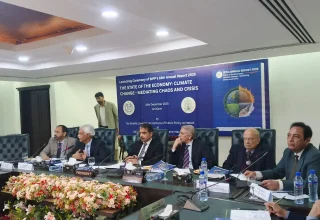
The Lahore Chamber of Commerce and Industry (LCCI) hosted the unveiling of the 18th Annual Report of the Shahid Javed Burki Institute of Public Policy (BIPP), titled “The State of the Economy: Climate Change-Mediating Chaos and Crisis.” The event drew economists, policymakers, academics, environmental specialists, business leaders, and civil society representatives to examine how climate pressures are reshaping Pakistan’s economic outlook.
LUMS Rector Shahid Hussain, who attended as chief guest, said climate change must be addressed as a central economic issue, warning that delayed action could intensify fiscal stress, inequality, and governance failures. He emphasized stronger collaboration between research institutions, universities, and the private sector to guide long-term, sustainable policy decisions.
Opening the session, LCCI President Faheem ur Rehman Saigol pointed to the rising costs of climate-related disruptions for businesses and industry, calling for policies that balance economic growth with climate resilience.
BIPP Chairman Shahid Javed Burki, presenting the key findings of the report, described climate change as a structural risk capable of undermining growth, social stability, and state capacity. He noted that recurring floods, heatwaves, and resource stress are already placing a heavy burden on the economy and public institutions.
Former IBA Executive Director Dr. Farrukh Iqbal provided a broader assessment of the economy, while BIPP Research Fellow Firas Shams outlined policy recommendations. These included climate-resilient development planning, governance reforms, expanded social protection, and targeted adaptation strategies to reduce the economic impact of climate shocks.
Additional perspectives were shared by Dr. Arifa Tahir of Lahore College for Women University and Dr. Mohammad Nizamuddin, Chairman of KITAAS, who stressed the importance of scientific research, data-driven planning, and public awareness in responding to climate risks.
The session concluded with a vote of thanks by Dr. Ejaz Sandhu, Director Research and Coordination at BIPP. The report urges policymakers to treat climate change as a defining economic challenge and to adopt timely, evidence-based reforms to prevent deeper crises in the years ahead.