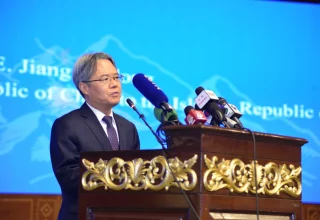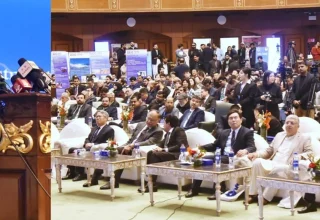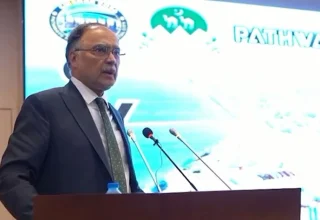
The Pakistan Institute of Development Economics (PIDE) hosted a seminar on “The Challenges of Low Savings in Pakistan,” chaired by PIDE Vice Chancellor Dr. Nadeem Javaid. The keynote address was delivered by Sohaib Jamali, Additional Director and Division Head at the State Bank of Pakistan, while Dr. Haider Ali, Director of PIDE’s Macro Policy Lab, served as discussant. The session was moderated by PIDE Research Economist Amna Riaz.
Mr. Jamali opened the discussion with fresh insights from the State Bank’s research, noting that Pakistan’s domestic savings rate has hovered between 12 and 15 percent for nearly two decades—well below the 20 percent threshold considered necessary for sustained economic growth. He described the shortfall as structural, shaped by low and volatile growth, high inflation, a large youth population, widespread informality, and a shallow financial sector. Even compared with similar economies, Pakistan continues to lag in savings.
He explained that while households do save, persistent public sector dissaving and weak financial intermediation limit the impact. Much of household savings through National Savings Schemes, mutual funds, insurance pools, and bank deposits eventually flow into government securities, where spending efficiency remains limited. Real returns on formal instruments have often been low or negative, pushing savers toward gold and real estate. Household surveys show that most Pakistanis consume first and save what remains, while rising expenses, low educational attainment, and gaps in financial literacy further suppress savings. The discontinuation of postal savings in 2021 removed a critical last-mile channel for low-income households.
Dr. Haider Ali praised the analysis for its depth, emphasizing that Pakistan’s savings challenge spans economic, demographic, institutional, and behavioral dimensions. He noted that low domestic savings are a symptom of deeper structural issues, including poverty affecting about 45 percent of the population and the shrinking middle class, which weakens the national savings pool.
In his closing remarks, Dr. Nadeem Javaid highlighted cultural and social factors influencing saving behavior. The housing shortage drives investment in real estate, while strong family networks and a culture of philanthropy reduce the incentive for precautionary savings. He cited international examples where mandatory long-term pension savings, supported by employer contributions and professional fund management, have mobilized stable capital for national development. Dr. Javaid stressed that Pakistan must raise its savings rate to at least 20 percent of GDP, alongside productivity growth and stronger financial institutions, to achieve ambitious economic goals.
The seminar concluded with a consensus that Pakistan’s savings challenge requires coherent, long-term economic and social reforms. Recommendations included rationalizing taxes on deposits, curbing speculative real estate investment, strengthening capital markets, expanding retail participation through asset management, broadening takaful and pension systems, restoring last-mile savings access via digital platforms, and building trust through stronger consumer protection and transparent regulation. Participants emphasized that higher savings must be paired with higher incentives to translate investment into sustainable economic growth.