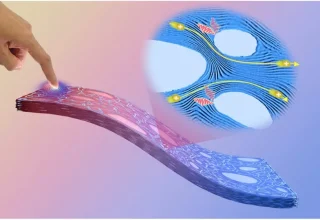
A Chinese research team has developed a highly efficient flexible thermoelectric polymer material that could support next-generation technologies, including wearable devices, adhesive cooling systems and Internet of Things (IoT) sensors, according to a study published in the journal Science.
Thermoelectric materials convert heat into electricity and vice versa, enabling power generation and refrigeration without the use of fuel or the production of pollution. Experts note that more than 60 percent of global energy is lost as waste heat, highlighting the potential of such materials in energy conservation and emission reduction.
At present, flexible inorganic thermoelectric materials can achieve a thermoelectric figure of merit (ZT value) of 1.4 at room temperature, while organic materials reach up to 1.2. However, complex manufacturing processes have limited their large-scale commercial application.
The new material, developed by researchers at the Institute of Chemistry under the Chinese Academy of Sciences, is called an irregular hierarchical-porous thermoelectric polymer (IHP-TEP). Led by Prof. Zhu Daoben and Prof. Di Chong’an, the team reported that the material achieves a ZT value of 1.64 at 343 kelvin (around 70 degrees Celsius), setting a new benchmark for flexible thermoelectric materials in this temperature range.
Researchers said the unique structure significantly reduces heat conduction while creating efficient pathways for electrical charge transport, closely matching ideal theoretical models in thermoelectric performance.
The IHP-TEP film is also compatible with spray-coating technology, allowing for large-area, low-cost production similar to newspaper printing methods.
Due to its flexibility, the material can adhere to curved surfaces, expanding its potential applications in wearable electronics and IoT devices. It can also provide a stable power source for sensors deployed in diverse environments, generating electricity wherever a temperature difference exists, such as on the human body, building surfaces or outdoor installations.